
You had it in your basket, you waited a week, and now the listing says sold out. The price on the secondary market moved the same day. That is how LEGO retirement works, and it is why the phrase “LEGO sets retiring in 2026” sends so many collectors into a panic buy.
Here is the part almost nobody tells you: LEGO does not publish a dated retirement calendar. The only forward-looking signal the company gives is the “Retiring soon” label on a product page, and its own availability page never promises a date in advance (LEGO’s own availability definitions, read 2026-10). Every 31 July and 31 December 2026 date you see circulating traces back to Brickset’s exit-date listings or to fan trackers, not to a LEGO announcement.
That gap is where money gets lost. LEGO’s Retiring Soon collection showed 270 products at the time of writing, while StoneWars’ retirement tracker expected more than 500 sets to leave in 2026 and Jay’s Brick Blog’s September 2026 tally counted over 300 on LEGO’s regional pages. Three numbers, three different questions.
The nine sets below are ranked by how much collector demand and retail scarcity they combine: flagship status, display presence, and how hard the box already is to find at retail price. This is the best LEGO sets to buy before retirement shortlist, ordered from the set most likely to anchor a collection to the one most likely to complete it.
What it actually means when a LEGO set retires?

“Retiring soon” and “Retired Product” are not the same thing, and the difference decides whether you can still buy at retail. LEGO’s own availability definitions describe “Retiring soon” as sets that will be retired very soon, while “Sold out” means stock is gone but more may arrive on an unconfirmed date, and “Retired Product” means the set is out of the assortment for good.
The same page lists no publication date and no future retirement schedule, which is the whole problem: the only forward signal LEGO gives is that one label (LEGO’s availability statuses page, read 2026-10). Retirement itself is routine housekeeping rather than an event. LEGO’s 2025 annual report records a portfolio of 868 products, up from 840, about half of them new, so roughly half the catalogue turns over in a normal year.
LEGO’s help page for retired sets gives the company’s own reason, that designers stop making older sets to make room for new ideas, and points buyers to BrickLink as the place to find them. StoneWars adds a practical warning the official page omits: production often ends well before the listed date, so a set can become hard to find months early (StoneWars’ retirement tracker).
Key Takeaway: “Retiring soon” is LEGO’s only forward-looking signal; “Sold out” and “Retired Product” mean different things.
Which LEGO sets retiring in 2026 are confirmed and which are still expected?
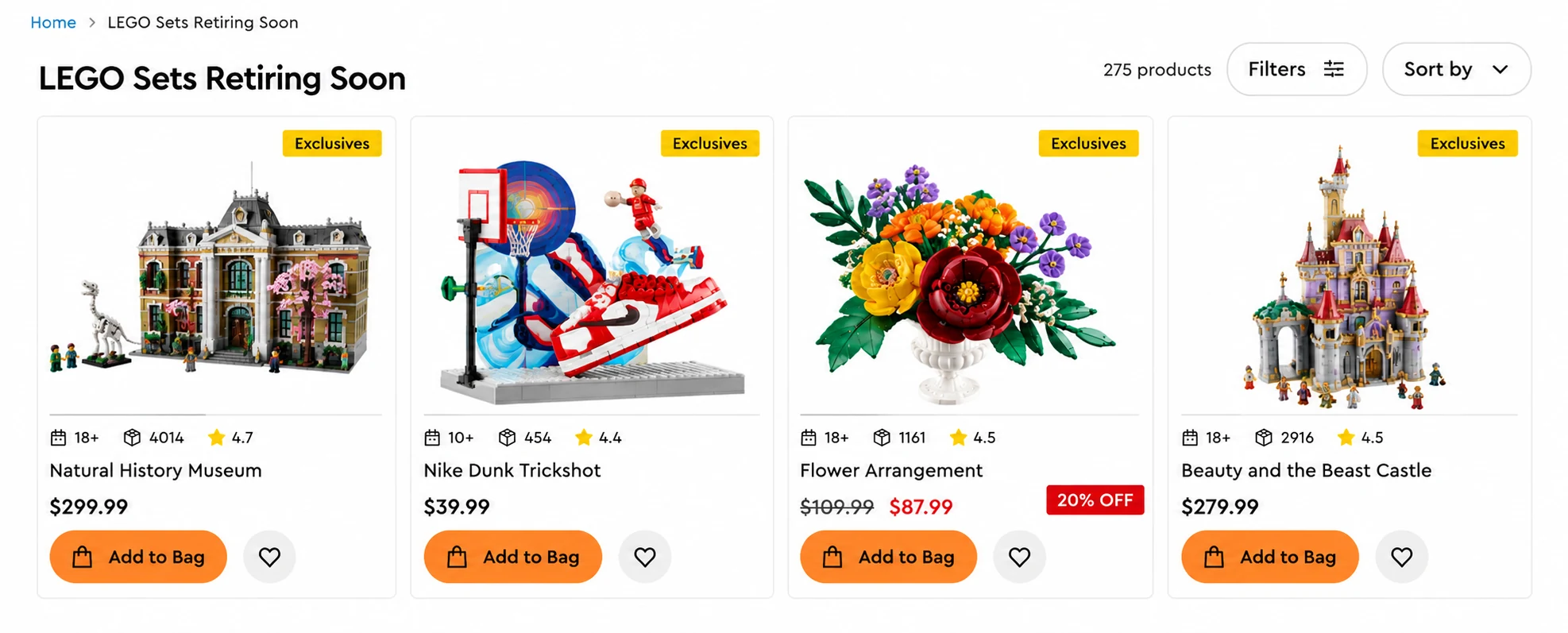
Nothing on this list is confirmed by LEGO in the sense most readers mean. The strongest first-party evidence is a label, not a date: LEGO’s Retiring Soon collection carried 270 products when read, with no page date, and that count moves as stock sells through.
Fan tallies measure something else. Jay’s Brick Blog’s September 2026 tally counted over 300 sets across LEGO’s regional Retiring Soon pages, while StoneWars’ retirement tracker recorded more than 130 items with a 31 July 2026 date, including 21 exclusive sets, and more than 500 sets expected to retire across the year.
The dates themselves come from a database convention. Brickset’s exit-date listings assign a systematic exit month to each set, which is why so many share 31 July or 31 December rather than a spread of real dates.
Warning: These totals come from different sources counting different things. Adding them together produces a number no source supports.
When the 2026 retirement deadlines fall?
Two dates carry almost all the weight. Brickset’s 31 July 2026 exit list runs to 5 pages of results, and Brickset’s December 2026 exit list runs to 14, which tells you the year-end wave is roughly three times the size of the mid-year one.
Treat December as a direction rather than a deadline. The UK price and piece-count list describes 31 December as a soft deadline, not a guaranteed one, because small sets and gift-with-purchase items disappear from LEGO.com weeks earlier.
The December count also depends entirely on scope. GameRant counted 34 video-game-themed sets ending in 2026, while LendABrick’s UK list runs to well over 100 models across nearly every theme. Those are different denominators, and neither is a total for all 2026 retirements.
1. The Lord of the Rings: Rivendell (10316) – Best for display centrepiece collectors
Rivendell is the set people build once and never take apart, and its exit date is the standard year-end one. Brickset’s December 2026 exit list carries 10316 with a 31 December 2026 date, which is a database convention rather than a LEGO commitment.
The case for buying it now is display footprint rather than speculation. It is a large, wide build that needs a dedicated surface, and sets of that size are the ones collectors most often regret passing on because there is no easy substitute once the theme moves on.
If you have the shelf space and the theme matters to you, this is the one to prioritise. If you are buying it as an investment, the spread in the value data below should temper that.
2. The Millennium Falcon (75192) – Best for Star Wars collectors who want the flagship
This is the only set on the list where LEGO itself is signalling retirement. The product page for the 7,541-piece Millennium Falcon shows the “Retiring soon” label at $849.99, which is the closest thing to a first-party confirmation that exists.
UK pricing for the same set is £734.99 at 7,541 pieces (the UK price and piece-count list). Polygon’s report on the December retirees names it among sets retiring at the end of 2026, but attributes the list to Brick Fanatics rather than to LEGO, so the end-of-year date is second-hand even though the “Retiring soon” label is not.
That combination makes it the strongest buy signal in this article: a first-party label plus a nine-year production run since its 2017 release.
3. The Endurance (10335) – Best for history and exploration collectors
The Endurance sits in the same year-end wave as Rivendell, with a 31 December 2026 exit date on Brickset’s December 2026 exit list, and it is one of the sets Jay’s Brick Blog flags as a priority pickup before retirement.
It is priced at £229.99 for 3,011 pieces (the UK price and piece-count list), which puts it in the mid-tier where collectors are most likely to wait for a discount that may never come once stock thins.
The practical issue with a set this size is storage and shipping. A large boxed set needs a dry, temperature-stable space, and shipping it later costs more than a small set, which eats into any resale margin.
4. NASA Artemis Space Launch System (10341) – Best for space and engineering collectors
The Artemis SLS is the crossover set on this list: it appeals to people who follow the actual programme as much as to LEGO collectors. It appears in LEGO’s Retiring Soon collection under the Exclusives label, which is the first-party signal that matters here.
Pricing is £219.99 for 4,601 pieces (the UK price and piece-count list), a piece-to-price ratio that makes it one of the better-value large builds retiring this year.
Its exit date follows the year-end convention on Brickset’s December list. The crossover audience is also its risk: if the space programme fades from the news cycle, demand after retirement may not follow the pattern collectors expect.
5. Optimus Prime (10302) – Best for crossover and nostalgia collectors
Optimus Prime has the shortest window on this list. It appears on Brickset’s 31 July 2026 exit list, which means the mid-year wave takes it roughly five months before the December sets go.
It is also one of the sets Jay’s Brick Blog names as a priority pickup before retirement, and it sits in LEGO’s Retiring Soon collection at $179.99 for 1,508 pieces.
The nostalgia audience is broad, but the set has been on shelves long enough that most people who wanted one already bought it. That is the tension with mid-year retirements: less time to decide, but also less pent-up demand.
6. PAC-MAN Arcade (10323) – Best for retro gaming collectors
PAC-MAN Arcade retires in the mid-year wave on Brickset’s 31 July 2026 exit list, alongside a cluster of other gaming and retro-themed sets.
The set’s appeal is that it is a working arcade cabinet in brick form, which gives it a display function beyond the build itself. That matters for resale, because sets with a mechanical or interactive element tend to hold interest longer than static models.
It is also the kind of set that sells out quietly. Mid-year retirements get less press than the December wave, so stock can disappear before most collectors notice the label changed.
7. Dungeons & Dragons: Red Dragon’s Tale (21348) – Best for tabletop and fantasy collectors
Red Dragon’s Tale is an Ideas set, which means it was produced in a single run and will not be reissued in the same form. It carries a 31 July 2026 exit date on Brickset’s 31 July 2026 exit list.
The tabletop crossover is the reason to move early. Dungeons & Dragons players who buy it are not LEGO collectors first, so the buyer pool after retirement is wider than the usual aftermarket crowd.
Ideas sets also have a documented history of holding value better than comparable retail sets, though the study below shows that pattern is far from universal.
8. Jaws (21350) – Best for film and diorama collectors
Jaws is another Ideas set with a mid-year exit date on Brickset’s 31 July 2026 exit list, and it is the strongest diorama build in the retiring group.
Its value is in the scene rather than the piece count. Diorama sets photograph well and display well, which keeps them visible in collector communities long after retirement and sustains demand.
The counter-argument is that film-licensed sets depend on the licence staying culturally relevant. Jaws has held up for fifty years, which is a better track record than most licences on this list.
9. The Great Pyramid of Giza (21058) – Best for architecture line completists
The Great Pyramid retires mid-year on Brickset’s 31 July 2026 exit list, and it is the one set here bought mainly by people completing a line rather than by casual fans.
Architecture collectors are the most completion-driven group in the hobby, which creates steady demand for a retired set even when the set itself is not spectacular. StoneWars lists it at $129.99 with a 31 July 2026 date (StoneWars’ retirement tracker).
If you already own other Architecture landmarks, this is the one where waiting costs you the most, because the buyer pool after retirement is small but determined.
Will retiring LEGO sets actually go up in value?
Usually, but not reliably, and the median hides a wide spread. A study of 4,415 retired sets published on 5 September 2026 found median market-value changes of +6.9% at three months, +22.3% at 12 months, +41.0% at 24 months and +157.1% at 120 months.
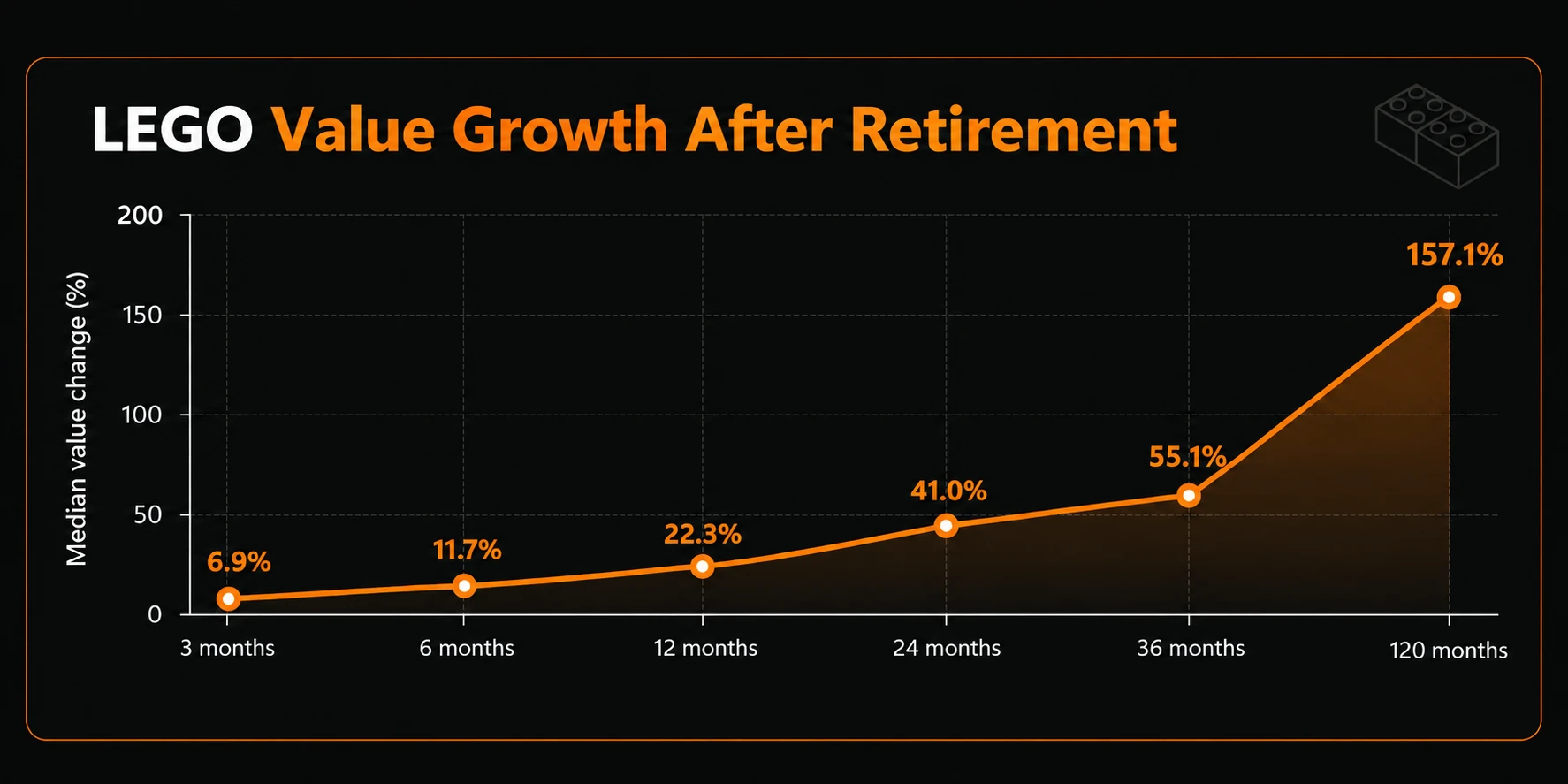
The other side of that median matters more. The same study found 26.5% of sets showed no positive change after three months, 18.8% after 12 months and 13.5% after 24 months, and the 25th percentile at 12 months was only +4.3% (Brickfact end-of-life study). A quarter of retired sets barely moved.
The study is explicit that it describes an association rather than causation, and that its figures are market-value estimates for sealed sets, not sale proceeds. Brickfact’s year-on-year sample separately found estimated values rose a median 1.2% in the latest complete calendar-year comparison, with 45.1% of sampled sets not rising at all.
How to check whether a set is really retiring and what it is really worth
Work through four checks in order, and stop at the first one that fails. Start with the product page on LEGO.com and look for the “Retiring soon” label, which is the only first-party forward signal (LEGO’s availability statuses page).
Second, check Brickset’s exit-date listings for the set number and note the exit month, remembering that this is a database convention rather than a LEGO statement.
Third, look at completed sales rather than asking prices, because Brickfact end-of-life study measures market-value estimates for sealed sets and warns that an estimate is not a realised sale.
Fourth, subtract your costs before deciding anything is profitable. BrickLink’s commission table charges 3% of order total up to $500, then 2% on $500 to $1,000 plus 1% above $1,000, and states no payment-processing fee on the policy page.
How to store and sell a retiring set without losing money on condition, fees or storage
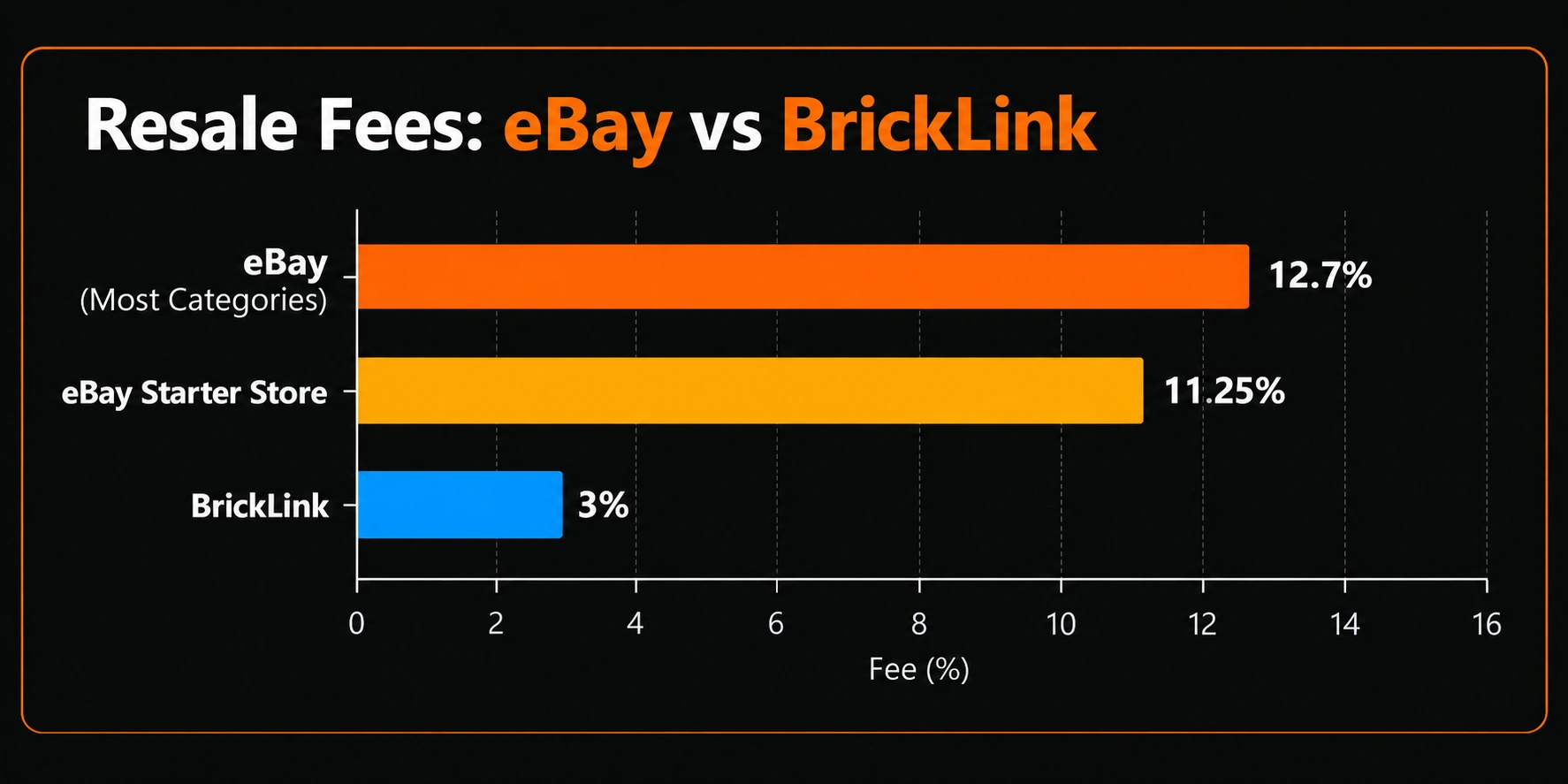
Fees are the first thing that eats a margin. eBay’s published fee schedule lists a 12.7% final value fee for most Toys & Hobbies and Collectibles sales up to $2,500, then 2.35% above that, plus a per-order fee of $0.40 on orders over $10. BrickLink’s equivalent is 3% up to $500 (BrickLink’s commission table), which is why many sellers list there first.
Storage is the cost nobody models. Brickfact end-of-life study states plainly that its figures exclude fees, postage, storage costs and inflation, so the headline percentages are not what a seller keeps.
Condition is the third variable, and it is the one you control. Sealed boxes hold their value; opened sets with sun-faded boxes or missing pieces trade in a different market entirely, which is why the study’s estimates apply only to sealed sets.
Conclusion
The honest summary of LEGO sets retiring in 2026 is that you are working with a label, not a calendar. LEGO’s own availability page gives you “Retiring soon” and nothing more, Brickset’s exit-date listings give you the 31 July and 31 December conventions that every other list copies, and the fan trackers give you counts that measure different things and cannot be added together.
Within that uncertainty, the nine sets above are the ones where demand and scarcity line up. The Millennium Falcon is the only one carrying a first-party “Retiring soon” label on the 7,541-piece Millennium Falcon product page. The mid-year group, Optimus Prime, PAC-MAN Arcade, Red Dragon’s Tale, Jaws and the Great Pyramid, gives you less time to decide. Rivendell, the Endurance and the Artemis SLS sit in the larger December wave.
Buy the set you actually want, at a price you would be happy with if it never rose a cent. A study of 4,415 retired sets found a rising median but also that 18.8% of sets had not risen a year after retirement, and the study’s own authors note it cannot tell you when to buy.
Before you check out, verify the current retirement status on LEGO.com, then check completed sales for the set number. If the label is still there and the sold prices make sense to you, buy it. If either check fails, wait.